Move your community from surviving to thriving
This 8-week, healing-centered curriculum gives you the framework, the facilitation skills, and the somatic tools to lead real recovery — for the people you serve, and for yourself.
"Awareness is where the work begins — resilience is where it takes root, and I'm here to walk that whole path with you."
— DaMond Holt, PhD

What you'll learn
What you'll be able to do
- Distinguish between trauma-informed care and trauma-resilient wellness, and articulate why the shift from awareness to active healing matters
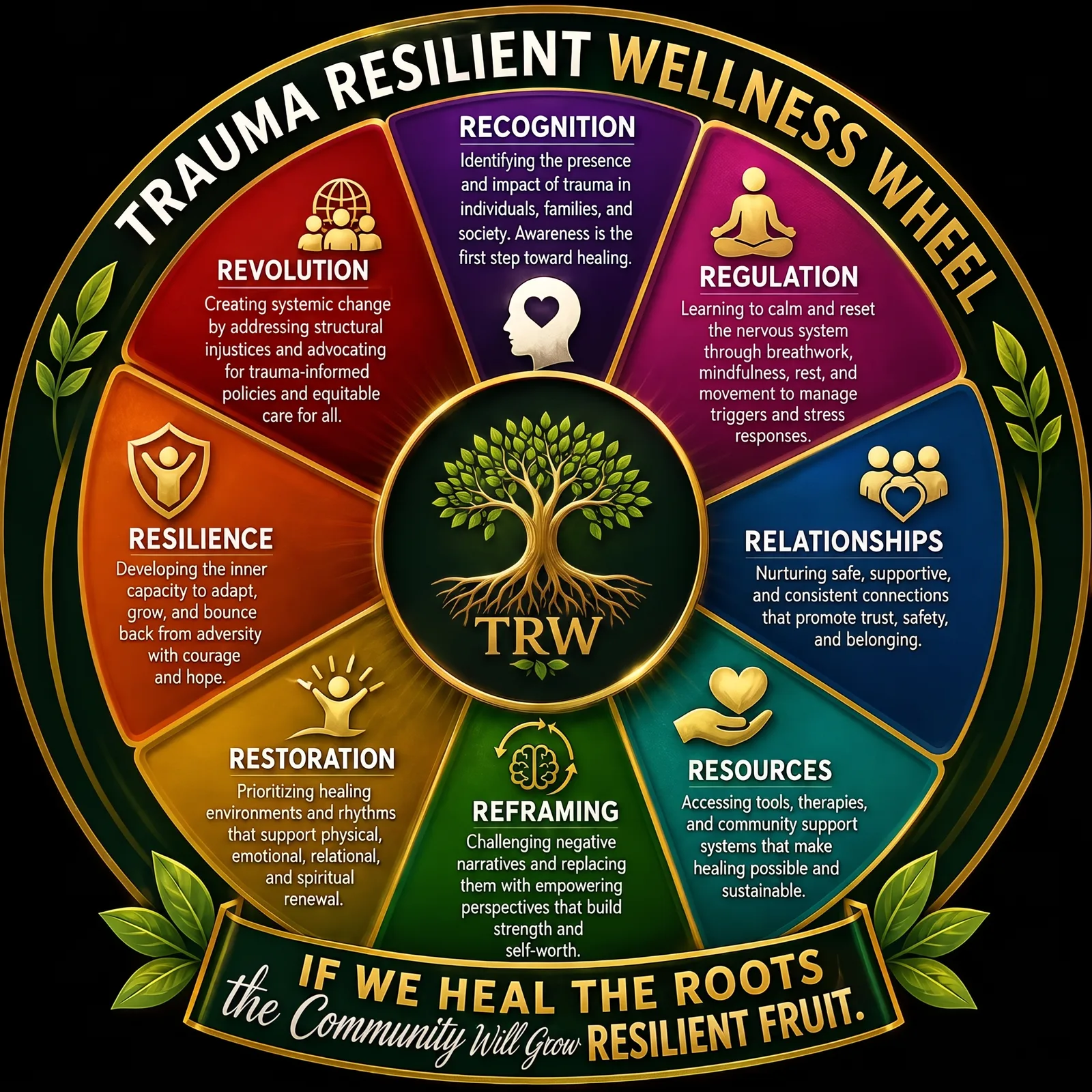
- Recognize the 8 Pillars of Resilience and apply them as a practical daily framework for themselves and the people they serve
- Facilitate a trauma-safe Healing Circle using restorative questions and a predictable session rhythm that creates psychological safety
- Identify how systemic stressors — poverty, incarceration, environmental harm, addiction — manifest as survival behaviors rather than character flaws
- Guide participants through somatic and reflective practices (journaling, body-awareness, identity work) that process trauma stored in the nervous system
- Design and deliver a TRW session sequence — from psychoeducation through self-reflection — rooted in healing-centered accountability and community restoration
How it works
A school that adapts to you
This isn't a set of static videos. Every lesson is generated live and tuned to where you actually are.
We learn your level
A quick placement check tailors your starting point so you're never bored or lost.
Lessons adapt as you go
Each lesson is written for your pace and your goal, adjusting as your skills grow.
Your AI coach keeps you moving
Checkpoints, feedback, and gentle nudges turn progress into a real result.
The curriculum
What's inside your school
6 modules · 29 lessons

Foundations of Trauma-Resilient Wellness
Establishes the core philosophy of TRW, distinguishes it from trauma-informed care, and introduces the public health lens through which trauma is understood.
- 1.1What Is Trauma? Roots, Not Just BehaviorsIncluded
- 1.2From Trauma-Informed to Trauma-Resilient: The Shift That Changes EverythingIncluded
- 1.3Survival Responses Are Not Character FlawsIncluded
- 1.4Systemic Trauma: Poverty, Incarceration, and Environmental HarmIncluded
- 1.5The TRW Core Philosophy and Restorative QuestionsIncluded
- 1.6New lessonIncluded
The 8 Pillars of Resilience
Introduces each of the 8 Pillars of Resilience as a practical, daily-use framework for personal healing and for serving trauma-impacted communities.
- 2.1Overview of the 8 Pillars: A Map Toward ThrivingIncluded
- 2.2Pillars 1 & 2 — Recognition and SafetyIncluded
- 2.3Pillars 3 & 4 — Connection and IdentityIncluded
- 2.4Pillars 5 & 6 — Purpose and EmpowermentIncluded
- 2.5Pillars 7 & 8 — Restoration and CommunityIncluded
Trauma in the Body: Somatic and Reflective Healing Practices
Teaches evidence-grounded somatic and reflective tools that help participants process trauma stored in the nervous system — for personal use and practitioner facilitation.
- 3.1Trauma Lives in the Nervous System, Not Just MemoryIncluded
- 3.2Body-Awareness Practices for Nervous System RegulationIncluded
- 3.3Journaling as a Healing Tool: Writing Toward TruthIncluded
- 3.4The Take Off the Mask Practice: Identity and Protection WorkIncluded
- 3.5ACEs, Chronic Disease, and the Body-Mind ConnectionIncluded
Facilitating the Trauma-Safe Healing Circle
Builds the practical facilitation skills needed to lead a TRW Healing Circle — creating psychological safety, holding restorative dialogue, and managing trauma responses in the room.
- 4.1Predictability as Safety: The TRW Session RhythmIncluded
- 4.2Asking Restorative Questions That Open Rather Than ShameIncluded
- 4.3Holding Space: Facilitation Skills for Trauma-Safe DialogueIncluded
- 4.4When the Circle Gets Hard: Managing Disclosures and DysregulationIncluded
Healing-Centered Accountability and Community Restoration
Shifts the focus from individual healing to collective repair — building skills for restorative accountability, community-level wellness planning, and sustainable restoration.
- 5.1From Punishment to Restoration: Redefining AccountabilityIncluded
- 5.2Reentry, Recovery, and Rebuilding Trust After Systems InvolvementIncluded
- 5.3Addiction, Mental Health, and the Trauma UnderneathIncluded
- 5.4Building Resilient Communities: Root-Level Healing in PracticeIncluded
Designing and Delivering a Full TRW Session
Integrates all prior learning as participants design, practice, and refine a complete TRW session sequence ready for real-world delivery.
- 6.1Mapping Your TRW Session: From Pillar to PracticeIncluded
- 6.2Psychoeducation That Doesn't Re-TraumatizeIncluded
- 6.3Practitioner Self-Care and Vicarious Trauma PreventionIncluded
- 6.4Live Practice: Facilitating Your TRW SessionIncluded
- 6.5The Next Level — Leading Your Community Toward Resilient FruitIncluded
Who it's for
Is this you?

Reentry professionals
You walk alongside people leaving incarceration and need a framework that redefines accountability as restoration, not punishment.

Community health workers
You're on the front lines of community care and are ready to move beyond trauma awareness into facilitation skills that create real change.

School counselors & educators
You see survival behaviors in your students every day and want the language and tools to respond with clarity and compassion instead of discipline.

Healing practitioners
Whether you work in recovery, spiritual care, or holistic wellness, this curriculum gives you a structured, somatic-aware approach to collective healing.

Survivor-leaders
You've lived through it — and now you're ready to understand your own story and lead others toward the restoration you've already started building.

Social workers & therapists
You hold space for trauma every day and need practical facilitation tools — plus a self-care framework that protects you from vicarious trauma.
Questions
Frequently asked
Your teacher
A note from your teacher

DaMond Holt, PhD
If you've spent time in this work — really in it, not just reading about it — you already know the gap I'm talking about. You've sat in trauma-informed trainings, learned the vocabulary, nodded along to the ACEs data. And then you walked back into your clinic, your classroom, your reentry program, or your community — and you still didn't have a clear map for what to do with any of it. That gap is not your failure. It is a gap in what most training offers. And it is exactly why I built Trauma-Resilient Wellness.
I designed this curriculum because the people doing this work deserve more than awareness. Awareness without a framework can actually make things harder — you see more, you feel more, and you carry more without a reliable structure to hold it. The 8 Pillars of Resilience are that structure. They are a living, practical map that takes you and the people you serve from recognition all the way through to community restoration — one grounded step at a time.
What you'll find in this course is direct, plain language that treats you like the capable, committed person you are. We will not talk around the hard things. We will look at how systemic harm — poverty, incarceration, environmental trauma, addiction — gets lodged in the nervous system and shows up as behaviors that the world mislabels as character flaws. We will look at the body, not just the mind. We will do the identity work. And we will practice facilitation until it feels less like a skill set and more like second nature.
I also want to name something that does not always get said: this curriculum is for you, not just for the people in front of you. The somatic practices, the journaling, the "Take Off the Mask" work — these are not just tools to hand out. They are invitations for you to heal alongside the people you serve. Sustainable community healing requires that the people leading it are also tended to, and this course builds that into its foundation.
Whether you are a social worker, a counselor, a reentry coach, a pastor, a teacher, or a survivor ready to lead — you belong in this room. Come ready to be honest, to be stretched, and to leave with something real: a full TRW session you designed yourself, a framework you can use tomorrow, and a deeper sense of your own purpose in this work. That is my promise to you.
— DaMond Holt, PhD
Start your journey today
Join 1 others and get instant access — learn at your own pace with an AI coach in your corner.
$49/mo
Recurring billing · cancel anytime
Secure checkout · Instant access
- 6 modules, 29 lessons
- AI-adaptive lessons tuned to your level
- Quizzes & checkpoints to lock in progress
- Your own AI learning coach
- Learn on any device, at your pace
- Full access for as long as you're subscribed